The Antiverse Platform.
Our Platform designs developable, functional biologics for GPCRs and other challenging targets.
1
Generative AI design
Antibody and nanobody sequences generated de novo from target sequence alone — no existing ligand, binder, or prior campaign data required. This lets us work on targets other platforms can't approach.
4
Functional validation
Confirmed binders are run through functional assays against the disease-relevant receptor. Results feed directly back into the generative model, so the next design cycle starts smarter than the last.

2
Native context screening
Candidates are panned against the target receptor expressed in precisely-engineered cell lines, presenting them in their native membrane environment — the format GPCRs require to fold and behave correctly.
3
Multiparametric developability triage
Binders are clustered by epitope and by developability properties simultaneously, so a partner receives a diverse, developable panel. Diversity here hedges against later-stage developability issues.
100B Ab-ag interactions probed
10x faster molecular dynamics simulations (vs human)
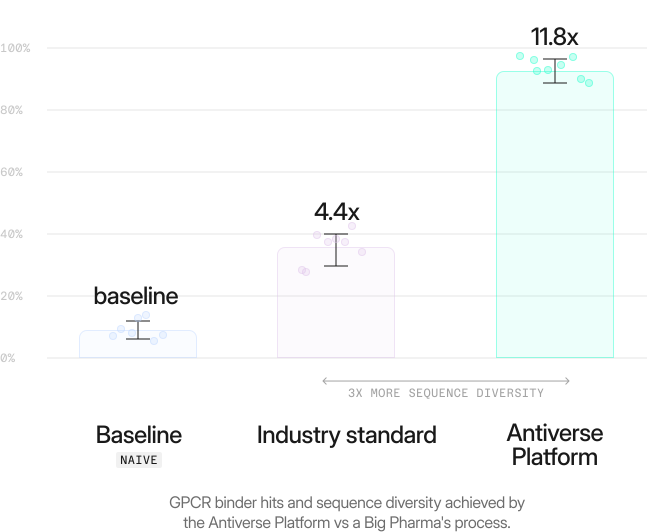
2000x greater hit rate vs naive library
100 million sequencing outputs
Computational Models
Interconnected intelligence layers work in sequence – from target identification to sequence refinement – each informing the next.
We employ sequence-based design and structure-based design – alongside AI-guided molecular dynamics – to identify high-potential binders for challenging GPCRs and transmembrane targets – including those with no known binders.
We combine biology expertise and purpose-trained AI models to design epitope-specific libraries that are enriched for functional binders – increasing the likelihood of selecting hits with the desired therapeutic function
Our ML models build in and filter for optimal therapeutic characteristics – safety, stability, cross-reactivity, etc. – from the first iteration, accelerating the path to the clinic.
Self-improving internal loop continuously refines our AI and ML models, generating better predictions at each turn – driving our proprietary data moat.
Read the peer-reviewed publication on biologics for GPCRs and the Antiverse Platform.
In-House Wet Lab

Our in-house wet-lab process, utilising cell lines expressing abundant amounts of receptors on the cell surface, provides us with strong confidence in our candidate performance.
Proprietary human stable cell lines present GPCRs in their native conformation, making a critical difference in accuracy and translatable hit discovery.
Cell-based functional assays confirm agonist, antagonist, or modulator activity, demonstrating therapeutic biological effect.
Rapid discovery of binding sequences, even for the smallest and most hidden epitopes, with quantitative affinity data, triaging candidates with speed and precision.
Wet-lab outputs feed directly back into our AI models, creating a closed-loop system that accelerates every subsequent design cycle.
Download the white paper on our proprietary stable cell lines for GPCRs and ion channels.
~800 unique sequences for a Class A GPCR identified using an optimised epitope-specific library designed by the Antiverse Platform.

>100 functional AGONISTS for a Class A GPCR confirmed by the Antiverse platform.

Publications