Biologics needed to treat many diseases 

don’t yet exist.

The opportunity

GPCRsGPCRs areare thethe largestlargest classclass ofof humanhuman drugdrug targets,targets, yetyet remainremain largelylargely untappeduntapped byby biologics.biologics.

GPCRsGPCRs areare thethe largestlargest classclass ofof humanhuman drugdrug targets,targets, yetyet remainremain largelylargely untappeduntapped byby biologics.biologics.

GPCRsGPCRs areare thethe largestlargest classclass ofof humanhuman drugdrug targets,targets, yetyet remainremain largelylargely untappeduntapped byby biologics.biologics.

Many GPCR targets still rely on small molecules with significant clinical limitations. Precise, targeted biologics can change that.

> 400

GPCRs and ion channels implicated in human disease.

> 100

Diseases where GPCRs play a significant role.

~ 34%

of all approved drugs target GPCRs, primarily via small molecules.

Most

GPCR targets have no approved biologics; no ion channels do.

EPITOPE SPECIFICITY

Epitope-SpecificEpitope-Specific SequencesSequences DesignedDesigned byby GenerativeGenerative AIAI

Epitope-SpecificEpitope-Specific SequencesSequences DesignedDesigned byby GenerativeGenerative AIAI

Epitope-SpecificEpitope-Specific SequencesSequences DesignedDesigned byby GenerativeGenerative AIAI

Our proprietary AI models design epitope-specific libraries enriched for functional, therapeutic biologics. 

We design the sequences to bind to the target at the exact location on the target that will confer the desired biological effect.

Our proprietary AI models design epitope-specific libraries enriched for functional, therapeutic biologics. We design the sequences to bind to the target at the exact location on the target that will confer the desired biological effect.

DESIGNED FOR FUNCTION

LibrariesLibraries EnrichedEnriched forfor FunctionalFunctional BindersBinders

LibrariesLibraries EnrichedEnriched forfor FunctionalFunctional BindersBinders

LibrariesLibraries EnrichedEnriched forfor FunctionalFunctional BindersBinders

By designing sequences that confer the desired function – agonism or antagonism – we prioritize biologic and therapeutic function from the start.

By designing sequences that confer the desired function – agonism or antagonism – we prioritise biologic and therapeutic function from the start.

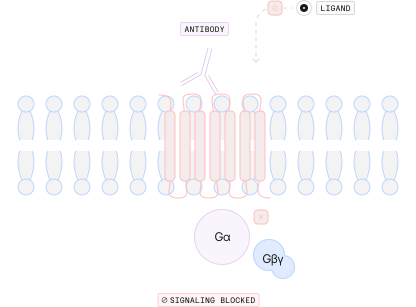
Agonist

The antibody binds and mimics the natural ligand — triggering downstream G-protein dissociation and intracellular signalling cascades.

Antagonist

The antibody occupies the binding site without activating — preventing endogenous ligands from engaging the receptor and halting signal transduction.

Antiverse combines 10 years of proprietary GPCR data with 240+ exclusive cell lines, creating a closed loop that continuously improves our AI models.

CELL LINE TECHNOLOGY

ScreeningScreening inin OverexpressingOverexpressing HumanHuman StableStable CellCell LinesLines

ScreeningScreening inin OverexpressingOverexpressing HumanHuman StableStable CellCell LinesLines

ScreeningScreening inin OverexpressingOverexpressing HumanHuman StableStable CellCell LinesLines

Our in-house engineered cell lines allow us to screen for GPCR binders in their native context - providing more surface area to successfully bind hidden, complex receptors, and increasing confidence that the hits are conformationally correct.
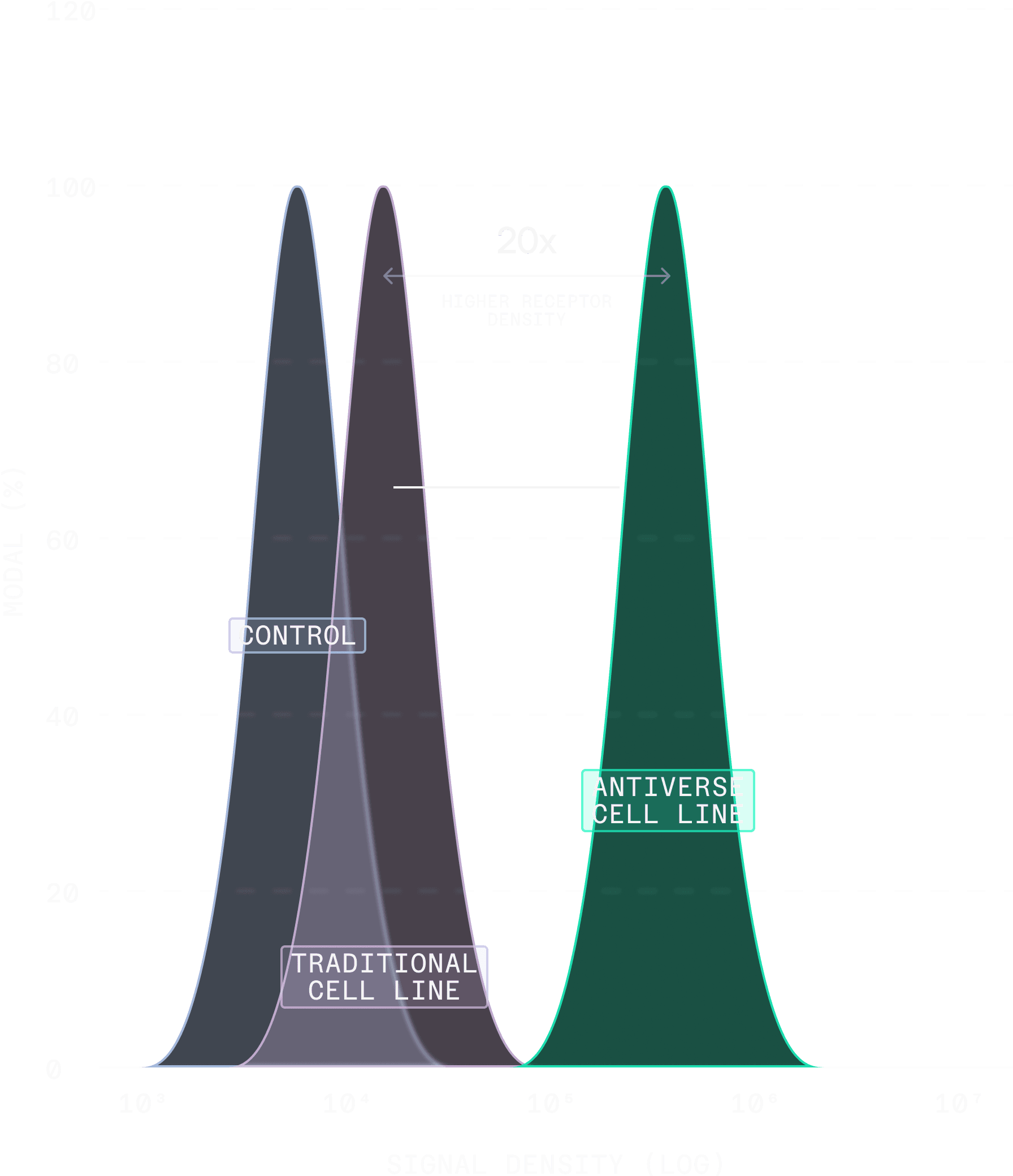
20x

Higher GPCR expression on Antiverse

human cell line vs traditional cell line

Higher receptor density means a more successful screening campaign for challenging targets like GPCRs.

More Clones Identified

Higher GPCR density means more epitopes are accessible. Antibody clones invisible in low-expression screens become clearly detectable with Antiverse cell lines.

More Clones Identified

Higher GPCR density means more epitopes are accessible. Antibody clones invisible in low-expression screens become clearly detectable with Antiverse cell lines.

Cleaner Signal-to-Noise

With 20× higher expression, even low-affinity binders produce a signal well above background, dramatically improving assay sensitivity and specificity.

Cleaner Signal-to-Noise

With 20× higher expression, even low-affinity binders produce a signal well above background, dramatically improving assay sensitivity and specificity.

Faster Hit Identification

Dense receptor coverage shortens the path from library screen to validated hit, reducing rounds of optimisation and accelerating your program timeline.

Faster Hit Identification

Dense receptor coverage shortens the path from library screen to validated hit, reducing rounds of optimisation and accelerating your program timeline.

THE DIFFERENCE

HighHigh ReceptorReceptor DensityDensity MeansMeans HigherHigher AntibodyAntibody HitHit RateRate

HighHigh ReceptorReceptor DensityDensity MeansMeans HigherHigher AntibodyAntibody HitHit RateRate

HighHigh ReceptorReceptor DensityDensity MeansMeans HigherHigher AntibodyAntibody HitHit RateRate

Antiverse-engineered stable cell lines precisely overexpress GPCR target receptors, allowing us to discover more antibody clones, without toxicity. By screening in their native context, we avoid the pitfalls of many traditional screening methods.

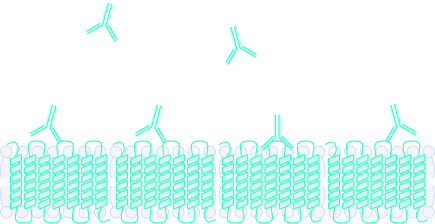
Traditional Cell Line

Low Hit Rate

Traditional Cell Line

Low Hit Rate

Our cell line

High Hit Rate

Our cell line

High Hit Rate